
01
Rutundu Log Cabins
Sunbird at Breakfast The story that defined it: On the night of 20 October 2010, Prince William drove up from the Lewa Wildlife Conservancy to two small cedarwood cabins on the shore of Lake...

Destination Guide
Mountain forests, highland air, adventure routes, wildlife corridors, and lodges around Mount Kenya.
Destination Guide
Africa's second-highest mountain rises to 5,199 metres above a landscape of equatorial forest, moorland, and glacial tarns. The conservancies and lodges on the mountain's lower slopes offer a cool-air safari experience unlike anywhere else in Kenya, with wildlife corridors that connect the highlands to the vast northern frontier.
Overview
A clear introduction to the landscape, rhythm, and reason this destination matters.

Overview
At its peak volcanic height, scientists estimate the original cone reached approximately 6,500 metres significantly taller than the current summit, taller than Kilimanjaro and among the highest volcanic edifices in Africa.
Overview
Since 2004, the rate of loss has accelerated dramatically. By 2016, the Lewis Glacier Mount Kenya's largest had lost 46% of its surface area and 57% of its volume in just 12 years. Between 2014 and 2016, two glaciers the Nothey and Darwin disappeared entirely.
Overview
The Lewis Glacier fragmented into two separate ice masses as a rock outcrop was exposed by the retreating ice. By 2024, satellite data showed that Mount Kenya's total remaining ice covered approximately 0.069 square kilometres just 4.2% of its original size as recorded in 1900.

Overview
The Lewis Glacier, once 0.678 square kilometres during the Little Ice Age, now spans barely 6.9 hectares 10% of its 1980s surface area, and shrinking at an accelerating rate of 3.8% per year.

Overview
The prediction of leading glaciologists, confirmed by UNEP, UNESCO and multiple independent research teams: Mount Kenya's glaciers will disappear entirely before 2030. Some scientists believe they may be gone sooner. The Human Cost: The glaciers' disappearance is not only an aesthetic tragedy. It is a water crisis in slow motion.
Overview
Lewis Pugh and the Current Campaign: In December 2025, Lewis Pugh — UN Environment Programme Goodwill Ambassador and endurance swimmer climbed Mount Kenya to stand beside the Lewis Glacier and speak directly about its condition. His assessment, given to Reuters: "The Lewis Glacier is right on the edge now.

Overview
So, we cannot be quiet on the disappearance of Africa's last glaciers." UNESCO hydrologist Alexandros Makarigakis has stated plainly: "Pretty soon we will have a generation that will never associate Africa with glaciers." What This Means for a Vard Africa Client in 2026: To climb Mount Kenya today and see the Lewis Glacier two small blocks of ice in a

Overview
You feel it physically: the lungs working harder, the pace slowing, the specific quality of exhaustion at 4,000 metres that is different from any tiredness at sea level. The body earns the summit. ✓ It is about botany of another world.

Overview
At 4,000 metres in the Afro-alpine zone of Mount Kenya, in the hour before dawn on the summit morning, the silence is total. The Laikipia plains are invisible below. The other trekkers are not there; there are no other trekkers. There is the trail, the headlamp, the cold and the specific silence of a place where almost nobody ever goes.

Overview
The specific opportunity to stand beside the Lewis Glacier to see what 4.2% of original ice coverage looks like in a valley that was once entirely filled with ice exists for a very short remaining window of time.

Overview
Giant lobelia (Lobelia telekii): up to 6 metres tall, a rosette of stiff, grey-green leaves arranged around a central spike of hundreds of blue flowers, pollinated by birds rather than bees (there are no bees at this altitude).
Overview
This is what guests see in the final hours before the summit: the headlamp beam on black rock, the cold at -10°C or below, the specific darkness of a pre-dawn equatorial high-altitude, and if they look up the stars through the thin, clear air at 4,000+ metres that are the finest night sky available anywhere on the Kenya journey.

Overview
The interiors are dark, warm, cedar-scented and fire-lit — the open log fires the primary heating source, the solar hurricane lamps the primary lighting. The word most accurately applied: rough-luxe — a deliberate, honest roughness that is entirely different from a compromise.
.webp?v=1787387197)
Overview
Both cabins must be booked simultaneously as there is only one kitchen. Self-Catering: Rutundu is fully self-catering. There is no restaurant, no shop and no provisions. Guests bring all their food and drink.
Hotels & Lodges
Hotels, lodges, camps, villas, private houses, facilities, room styles, dining, and the accommodation details guests need before choosing a route.
5 partner properties in Mount Kenya
Sunbird at Breakfast The story that defined it: On the night of 20 October 2010, Prince William drove up from the Lewa Wildlife Conservancy to two small cedarwood cabins on the shore of Lake...

The Kenya Wildlife Service operates and maintains a series of mountain huts along the three main routes. These are not luxury accommodation; they are proper mountain huts in the tradition of alpine climbing lodges...
For all Vard Africa clients, the preferred staging base before and after the mountain is Olepangi Farm in Timau 30 minutes from the Sirimon Gate, at 1,950 metres above sea level, providing natural pre-climb...
The Naro Moru River Lodge serves as the primary base for western approach climbers a historic mountaineering lodge with equipment hire, guide services, porter coordination and the Naro Moru River trout fishing. WHAT ARE...
The Burguret begins at Mountain Rock Lodge (1,950m) near Nanyuki or at the Gathiuru Forest Station and from the first day it is a different mountain from any other approach. There is no defined...
Wildlife
The species, conservation context, animal movement, birdlife, and sightings that define this destination.

Wildlife
The geological origin of the mountain is a story of volcanic violence on a scale difficult to comprehend from below. Approximately 3.1 million years ago, during the same tectonic activity that created the East African Rift Valley, a massive shield volcano began erupting at this position on the equator.

Wildlife
What guests see today is not the original volcano; it is what remains after millions of years of erosion, glaciation and the slow dismantling of the softer surrounding rock by ice and water.

Wildlife
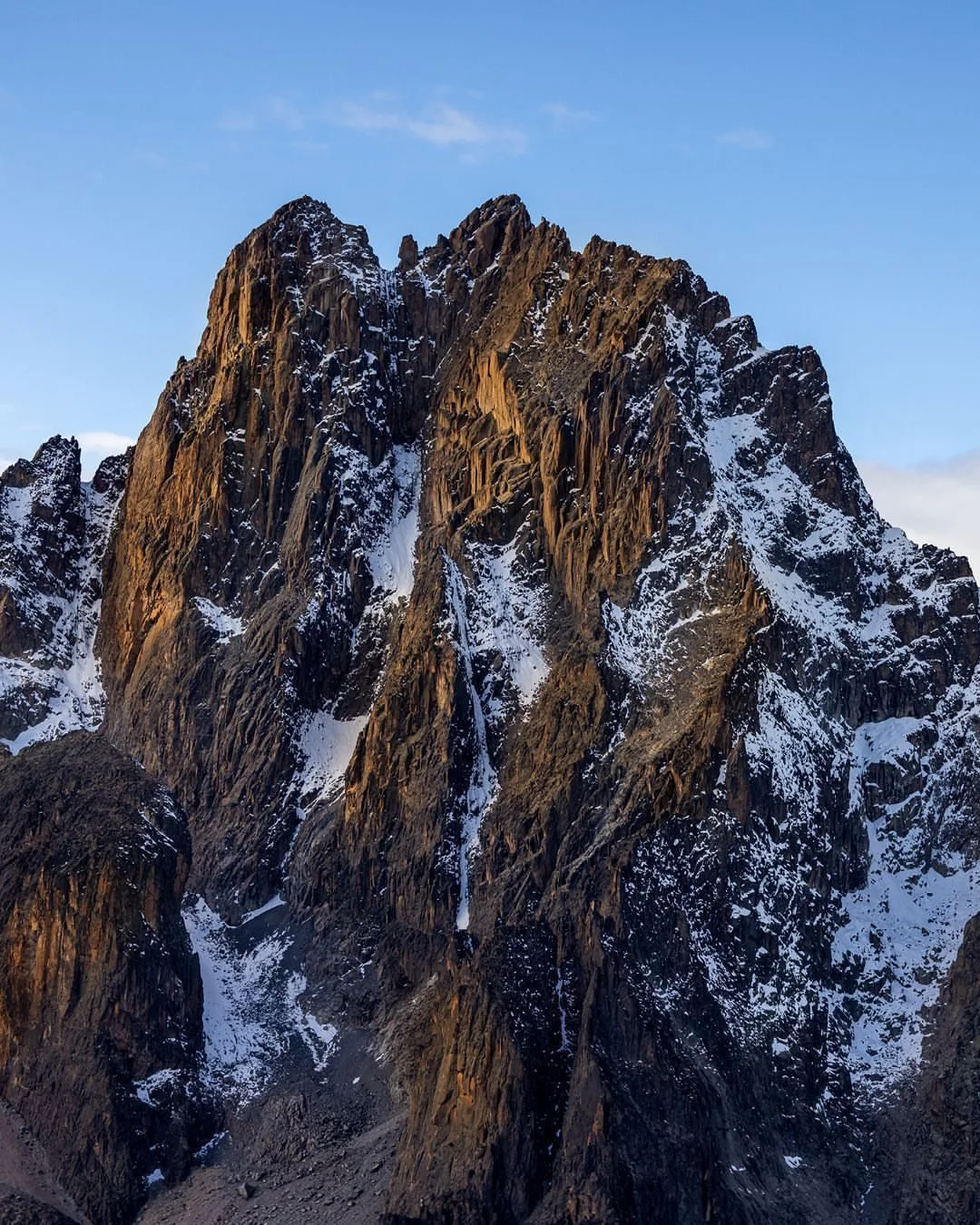
The multi- peaked summit Batian, Nelion and Point Lenana is the eroded, hardened remnant of the original volcanic plug, the last unconquered mass of ancient basalt and phonolite. The three summits define three different ambitions: ✓ Batian (5,199m) — the highest point in Kenya, named for a great Maasai laibon (spiritual leader).

Wildlife
A technical rock climb requiring advanced mountaineering skills, ropes, harnesses, rock climbing experience and considerable courage. Approximately 50 climbers successfully summit Batian each year. ✓ Nelion (5,188m) — named for Batian's brother, a Maasai chief. The second summit, slightly lower, equally technical, equally demanding, and often climbed in combination with Batian on the Southeast Face route.

Wildlife
UNESCO Recognition: Mount Kenya holds dual UNESCO status both a UNESCO World Heritage Site (inscribed in 1997, extended to include the Lewa Wildlife Conservancy in 2013) and a UNESCO Biosphere Reserve.

Wildlife
The World Heritage designation specifically cites the mountain's "outstanding examples of ecological evolution and processes" and its "wide range of rare and endemic species" the Afro-alpine flora that evolved in geographic isolation and exists nowhere else on Earth.

Wildlife
The Biosphere Reserve designation recognizes the mountain as a model of sustainable human-ecosystem coexistence the forests, the wildlife and the 2 million people who depend on its water all managed under a framework of acknowledged mutual dependence.
Wildlife
Over two million people directly depend on Mount Kenya's water. Every river that guests cross on the Laikipia circuit safari every waterhole that draws the elephants to Ol Pejeta, every river bank where Sasaab and Larsens Camp are positioned, every stream where the Kitich Forest Camp's trout are found originates in the glaciers and snowfields of this mountain.

Wildlife
✓ It is about fly fishing at altitude. Rainbow and brown trout introduced in 1905 now wild and mature in crystal mountain streams and crater lakes, caught in the company of buffalo on the moorland and eland grazing nearby. ✓ It is about the wildlife nobody expects. Forest elephant and leopard on the lower slopes.
Wildlife
Rock hyrax the elephant's nearest relative in the moorland. The scarlet-tufted malachite sunbird found only above 3,000 metres visiting the giant lobelia flowers at breakfast. The critically endangered mountain bongo in the bamboo. The melanistic black leopard documented in the Afro-alpine zone. ✓ It is about silence.
Wildlife
Tropical forest to bamboo to moorland to Afro-alpine to summit rock and ice each transition a completely different world, separated from the next by a few hundred metres of altitude. ✓ Two — The Wildlife Nobody Expects at Altitude: Buffalo on the moorland grass below you as you cast to rising trout.
Wildlife
Elephant in the bamboo forest as you approach the mountain. The malachite sunbird at the Rutundu Log Cabin breakfast table. The mountain bongo fewer than 100 individuals remaining in the wild, all on Mount Kenya in the forest below. The black leopard, camera-trapped in the Afro-alpine zone, whose territory includes the routes guests walk.

Wildlife
These are wildlife encounters of a completely different character from the game drive. ✓ Three — The Urgency of Now: The glaciers will be gone within a few years.

Wildlife
✓ Five — The Fly Fishing in the Middle of Africa: Rainbow trout in crystal alpine lakes and mountain streams, above 3,000 metres, on the equator. This specific combination the cold, clear water, the wild trout, the elephant grazing below in the bamboo, the mountain peaks above does not exist anywhere else in the world.
Wildlife
Zone One — The Montane Forest (1,600m–2,500m) Tropical Rainforest | Elephant, Leopard, Buffalo, Mountain Bongo, Colobus Monkey The mountain's lowest zone is tropical equatorial montane forest dense canopy of East African cedar (Juniperus procera), podocarpus, camphor, Meru oak and giant st. John's wort.

Wildlife
The forest is the mountain's richest zone for mammal diversity and the zone where the specific magic of the early approach hours is concentrated. African elephant move between the mountain's forests and the Laikipia plateau through wildlife corridors the same individuals that Ol Pejeta and El Karama guests observe on game drives sometimes spending weeks in the forest.
Wildlife
leopard. The critically endangered mountain bongo (Tragelaphus eurycerus isaaci): fewer than 100 wild individuals in the world, all in the Mount Kenya ecosystem, this spiral-horned forest antelope is one of the rarest large mammals on Earth. Colobus monkey in every canopy section; giant forest hog and bushbuck in the understory.
Wildlife
Zone Two — The Bamboo Forest (2,500m–3,000m) Dense Bamboo | Forest Elephant | The Transition Zone | Near-Darkness and Silence Above the mixed montane forest on the windward slopes, a zone of African mountain bamboo (Yushania alpina) growing to 15 metres creates the most dramatically atmospheric section of the lower mountain. The bamboo canopy filters light to yellow-green.
Wildlife
The specific sound of bamboo in wind is unlike any other forest sound. Navigation requires more attention; the tracks wind and the bamboo closes above. Forest elephant feed in the bamboo smaller, quieter and more secretive than their plains relatives, using the dense vegetation for shelter and the bamboo shoots for feeding. Buffalo in significant numbers.
Wildlife
Black-fronted duiker and giant forest hog in the undergrowth. On the Burguret Route especially, elephant encounters in the bamboo are so common that guides maintain heightened alert throughout this section.
Wildlife
Zone Three — The Heath and Moorland (3,000m–3,500m) Open Moorland | Giant Heather | Tussock Grass | Rock Hyrax | "Scotland with Lions" Emerging from the bamboo, the landscape opens dramatically the forest giving way to a moorland of giant heather (Erica arborea, Erica trimera) up to five metres tall, interspersed with tussock grasses (Festuca pilgeri), Alchemilla and Geranium.
Wildlife
The sky reappears. The summit peaks become visible for the first time. The temperature drops noticeably. This is the zone that prompted the description "Scotland with lions" the heather, the open moorland, the low cloud and the cold mist combining to produce an aesthetic that is simultaneously alien (equatorial light, volcanic rock, African wildlife) and deeply familiar.
Wildlife
The specific detail that makes it Kenya: rock hyrax the elephant's nearest living relative, despite looking nothing like one in colonies on every rocky outcrop, their morning sun-basking and their evening communal warmth-piling the most charming specific wildlife behaviour on the mountain. Eland the world's largest antelope grazing on the moorland grasses.

Wildlife
Zone Five — The Nival Zone (4,500m–5,199m) Rock, Ice and the Remnant Glaciers | Batian | Nelion | Point Lenana | The Summit Above 4,500 metres, most vegetation disappears. The zone is dominated by the ancient black volcanic rock of the original plug, interspersed with the remaining fragments of the glaciers that once covered the summit zone completely.
Wildlife
"Completely deteriorated and not for the faint-hearted." The reward for those who accept it: the visual journey through the mountain's forest zones and the specific sense of earned arrival at the cabin door. THE MOUNTAIN HUTS — Essential and Honest The Kenya Wildlife Service operates and maintains a series of mountain huts along the three main routes.
When to Go
Month-by-month context, weather, light, rainfall, wildlife visibility, and the best seasonal windows.
When to Go
THE ENVIRONMENTAL EMERGENCY A Mountain of Vanishing Ice — The Most Urgent Climate Story in East Africa What makes Mount Kenya uniquely urgent and what makes every visit to it a specifically charged experience in 2026 is what is happening to its ice. The glaciers of Mount Kenya are not retreating; they are vanishing.
When to Go
This has been destroyed by man." The local communities around the mountain's base are already experiencing the consequences: water levels in the Ngare Ngare River have dropped by 30% in a decade. 66% of residents along the Naro Moru River report reduced downstream flow. Rivers that ran year-round in their grandparents' childhood now run dry in the dry season.
When to Go
Unlike Kilimanjaro, where the debate has historically focused on deforestation of the lower slopes as much as temperature, Mount Kenya's glacier loss is directly and primarily attributed to human-induced climate change and global greenhouse gas emissions. The mountain's glaciers are a direct, visible, measurable consequence of what is happening globally to the atmosphere.
When to Go
valley the glacier once filled entirely is to witness one of the most specifically urgent and most specifically visible manifestations of climate change available to any traveller anywhere in the world.

When to Go
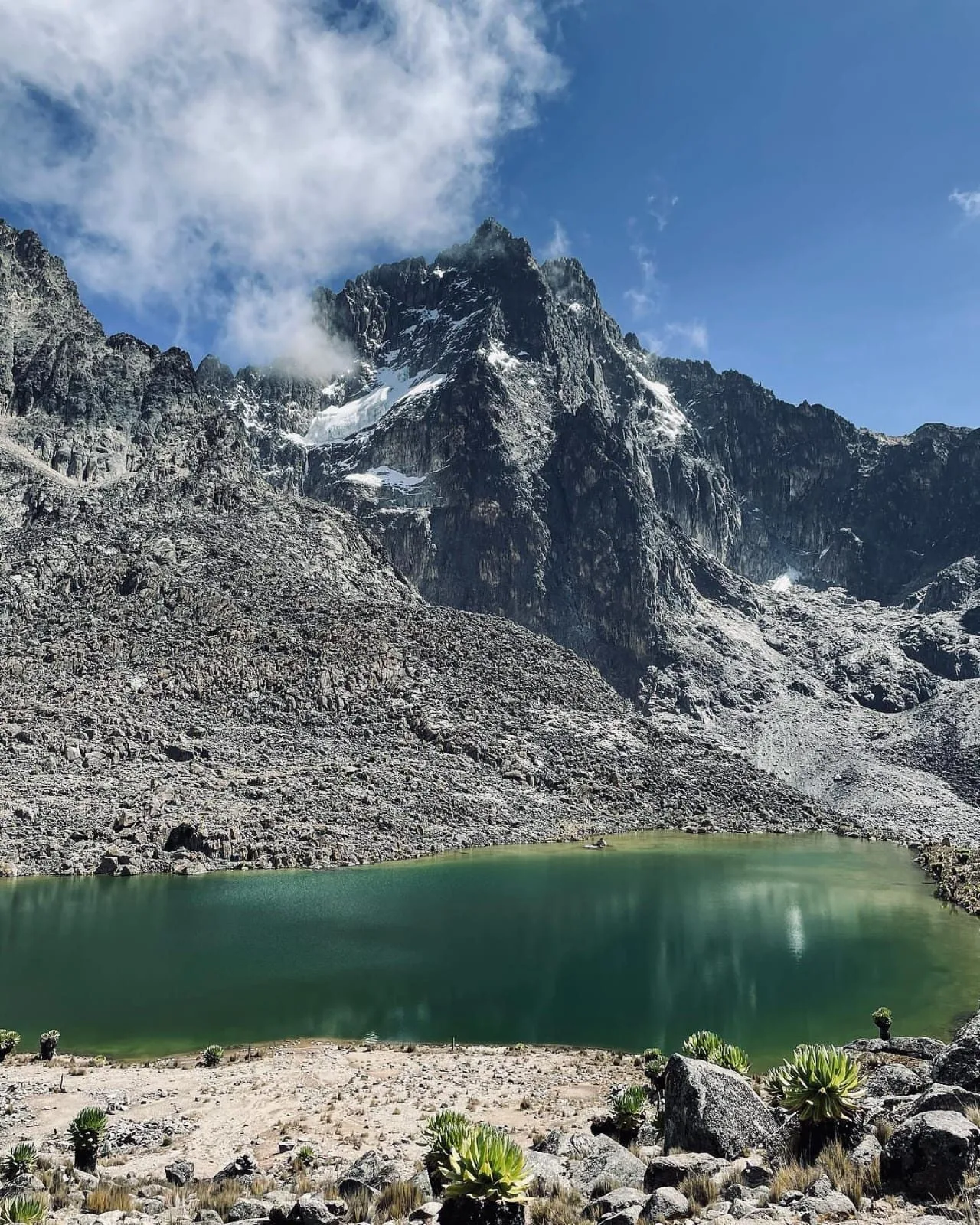
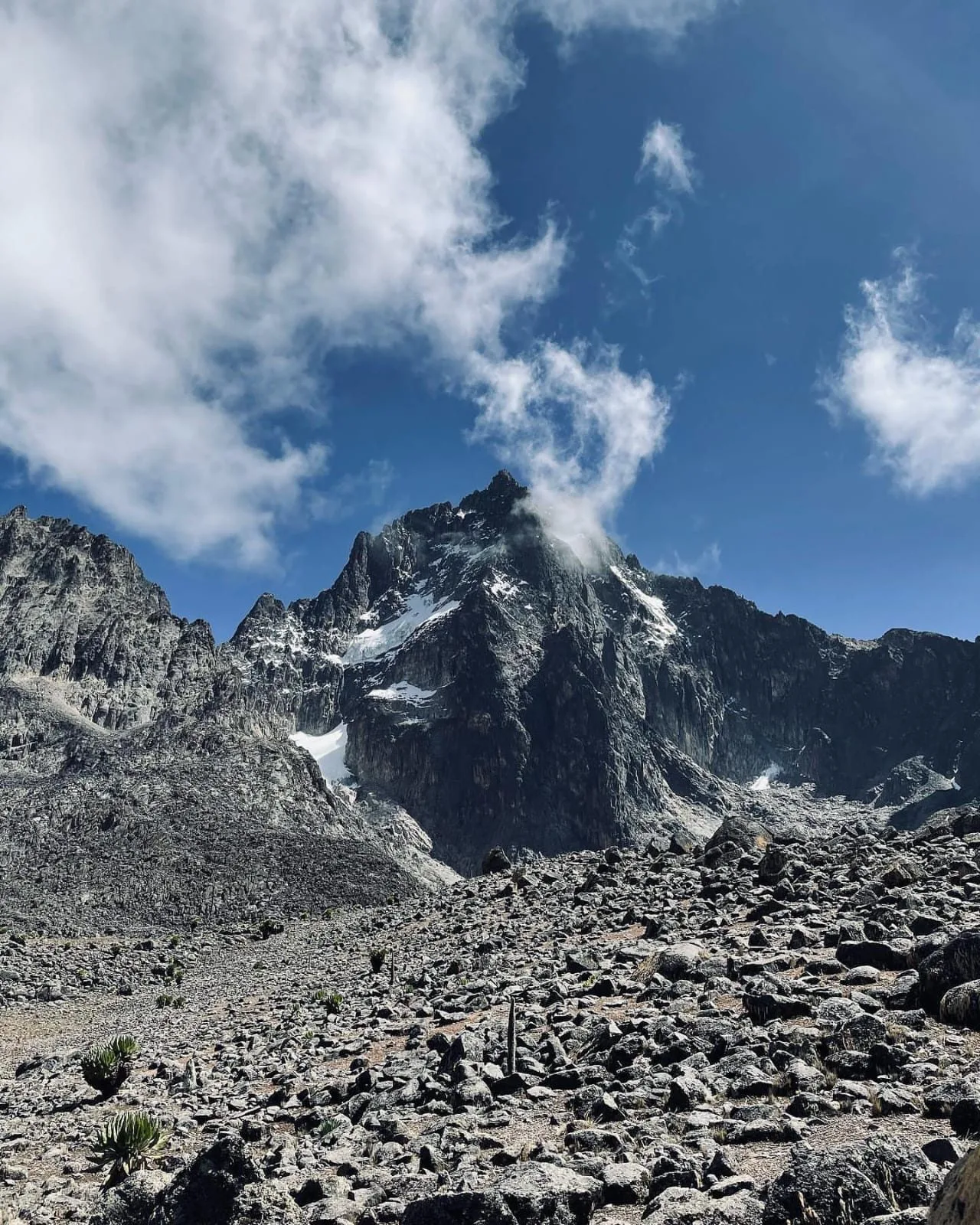
The valley that the Lewis once filled is now dry mud and moraine. The white summit that the Kikuyu called Kirinyaga place of brightness is largely brown rock. To visit the mountain in 2026 is to see something that will be gone within a few years.
When to Go
The forest receives up to 2,500mm of rainfall annually on the windward eastern slopes the density of the canopy and the constant moisture producing the specific atmosphere of a highland equatorial forest. The approach through the forest is a safari in itself before the climb has properly begun.
When to Go
The plant has evolved a specific biological adaptation to the conditions at 4,000 metres on the equator: the leaves fold inward at night, trapping warm air around the growing tip, preventing frost damage. The folded leaves trap water, creating a microclimate of warmth inside the plant while the surrounding air drops below freezing.
When to Go
This mechanism nocturnal insulation is unique in the plant kingdom. Giant groundsel (Dendrosenecio keniodendron): a tree-like composite plant growing to 10 metres, the trunk formed by accumulated dead leaf bases of decades of growth, the canopy a rosette of large leaves arranged to channel rainwater toward the root system. These plants live for 40– 60 years.

When to Go
The Lewis Glacier, now just two small blocks of ice in a valley they once filled entirely, is visible on the approach from the northwest. The moraines the ridges of rock debris left by the glacier's former extent are visible on every side, marking where the ice was and how far it has retreated.
In Detail
The deeper regional story: conservancies, private ranches, reserves, geography, access points, and how the destination fits together.
In Detail
THE MOUNTAIN Geology, Scale and Why It Matters Mount Kenya stands at 5,199 metres (17,057 feet) Africa's second-highest mountain, towering above the central Kenya highlands precisely on the equator at 0° latitude, between the foothills of the Aberdare Range to the west and the Meru and Kirinyaga highlands to the east.

In Detail
The water significance: Mount Kenya is the most critical water tower in Kenya the source of numerous major rivers including the Tana River (Kenya's longest), the Ewaso Nyiro River (which flows through the Samburu National Reserve and Laikipia), the Naro Moru River and dozens of smaller streams that sustain agriculture and human settlement across central Kenya.
In Detail
The timeline is not measured in centuries but in years. The Numbers — Documented and Alarming: In 1900, 18 glaciers covered the mountain's summit, spanning a total area of approximately 1.64 square kilometres. By 2004, the last comprehensive glacier inventory found only 10 glaciers remaining, covering just 0.27 square kilometres a loss of 84% in 104 years.

In Detail
When the Naro Moru guide Lawrence Gitonga who has climbed the mountain for 35 years describes the Lewis Glacier as he first saw it, his language is of fear: "I was terrified of the hulking white mass." When he describes it today: "It's so small and sad.
In Detail
What Is Causing This: The scientific consensus is clear. The primary driver is atmospheric drying reduced cloud cover, reduced snowfall, reduced albedo driven by rising global temperatures. The mountain's position on the equator makes it acutely sensitive to changes in moisture patterns.
In Detail
The generation of guests currently climbing to Point Lenana may be the last who see ice on Mount Kenya at all. The generation after them will arrive to a mountain whose name still carries the memory of glaciers, but whose summit no longer does. This is not a reason to avoid the mountain.
In Detail
The Afro-alpine zone of Mount Kenya contains plants that look designed for another planet: giant lobelias and giant groundsels evolved in total geographic isolation, found nowhere else on Earth, adapted to conditions equatorial position, extreme altitude, frost every night, intense sun every day that no other ecosystem on Earth combines.

In Detail
The view from Point Lenana at dawn the Laikipia plateau below to the west, the Samburu lowlands to the north, the Indian Ocean shimmer to the east on the clearest mornings, Kilimanjaro's silhouette on the southern horizon at over 300 kilometres distance is the same landscape that guests have been observing from safari vehicles all week.
In Detail
✓ Seven — The Completion of the Landscape: Guests who have spent a week on safari looking at the mountain from the plains describe the summit view as the moment when the entire Kenya landscape became comprehensible simultaneously.

In Detail
Mount Kenya stands precisely on the equator at approximately 0° latitude, 200 kilometres north of Nairobi in central Kenya's highland zone, rising from a plateau that lies between 1,600 and 2,000 metres above sea level to its summit at 5,199 metres.

In Detail
The centre of the Laikipia safari circuit. Naro Moru (West — 1,950m above sea level): The traditional starting point for the Naro Moru Route, 40 kilometres south of Nanyuki on the A2 highway. The Naro Moru River Lodge is the primary climbing base on the western side.
In Detail
Chogoria (East — 1,600m above sea level): The gateway to the eastern approach, 185 kilometres from Nairobi via the A2 highway north, then east. The most scenic approach to the mountain; the starting point of the finest trekking route.
In Detail
And replacing both, in isolated colonies and then in extraordinary concentration, appear the plants that have made the mountain world-famous in botanical circles and that leave every trekker reaching for inadequate words.

In Detail
The Afro-alpine zone contains the mountain's glacial lakes: Lake Michaelson, Lake Alice, Lake Rutundu, Lake Ellis crystal-clear, cold, oxygen- rich bodies of water in volcanic rock basins that sustain the trout populations the fly-fishing programme depends on.
In Detail
The Gorges Valley one of the most spectacular single landscape features in East Africa is a glacially carved trough whose walls rise 400 metres on each side, the floor carrying the Nithi River and its wild brown trout toward the lower mountain.

In Detail
Point Lenana at dawn: the summit cross, the 360-degree panorama, the shadow of the mountain extending westward across the Laikipia plateau to the Aberdare Range. On the clearest mornings: Kilimanjaro visible on the southern horizon. The Indian Ocean discernible as a shimmer to the east.
In Detail
They are built in the Alaskan log cabin tradition using large cedar logs harvested from the surrounding forest, the gaps between the logs filled with moss that serves as natural insulation against the cold that 3,100 metres on the equator produces every night.

In Detail
They will cook your trout, set the table on the verandah and make the morning coffee before the sunbird arrives. The Scarlet-Tufted Malachite Sunbird: This specific bird — found only above 3,000 metres on East and Central African mountains, drawn to the giant lobelia flowers adjacent to the cabin — appears at the verandah breakfast table most mornings.
In Detail
For all Vard Africa clients, the preferred staging base before and after the mountain is Olepangi Farm in Timau 30 minutes from the Sirimon Gate, at 1,950 metres above sea level, providing natural pre-climb acclimatisation while guests stay in Elizabeth and Clinton's farm environment.
In Detail
As described in the Laikipia Ecosystem guide, Olepangi is the most personally hosted highland farmhouse in the Nanyuki area. The sequence Vard Africa recommends: 2 nights at Olepangi (acclimatisation and preparation) → Sirimon Gate climb → return to Olepangi for 1 night's recovery before continuing the safari or departing.
Experiences
Game drives, walks, riding, cultural immersion, conservation activities, scenic flights, and special interests.
Experiences
It is the most specific and most urgent reason to go. WHAT ARE THESE EXPERIENCES ABOUT? The Mount Kenya experience is not a single thing. It is an accumulation of completely different encounters each one available nowhere else, each one adding a dimension to the Kenya journey that the safari alone cannot provide. ✓ It is about altitude.

Experiences
Going up ascending through five distinct ecological worlds in three to six days of walking, each world separated from the next by temperature and biology, until the summit zone of rock and ice is reached at almost five thousand metres. The mountain forces altitude.

Experiences
Walking through a field of 6-metre lobelias in the morning light is an experience that stays with guests permanently. ✓ It is about the glaciers while they exist. The specific opportunity closing fast to stand beside ice that has been on this mountain for thousands of years and is now in its final decade.
Experiences
WHY IS THIS A SPECIAL ADD-ON FOR ADVENTURERS? The guests for whom the Mount Kenya experience is specifically and powerfully right are guests who have reached a specific point in their safari life: they have done the game drives. They have mastered the binoculars. They know how to read the landscape from a vehicle.

Experiences
And they are ready for something that uses their bodies rather than their eyes. Seven specific reasons the mountain is the finest adventure add-on in the Kenya portfolio: ✓ One — The Vertical Safari: The ascent crosses more distinct ecosystems in three days than most Kenya safaris encounter in a week.
Experiences
The conservancies below, the rivers they have crossed, the distant mountains they have been told are there all visible at once from 4,985 metres. The safari gave them the ground-level experience. The mountain gives it its context. WHERE IS MOUNT KENYA?
Experiences
The mountain that frames the safari horizon is the same mountain guests can be climbing the morning after their final game drive. THE FIVE WORLDS OF MOUNT KENYA Altitudinal Zones — What Guests Encounter at Every Stage Mount Kenya does not have one landscape.
Experiences
It has five stacked vertically, each separated from the next by altitude, temperature and the specific ecology that altitude and temperature produce. Understanding these zones is the foundation for understanding what the climb experience actually is.

Experiences
Zone Four — The Afro-Alpine Zone (3,500m–4,500m) Giant Lobelias | Giant Groundsels | The Otherworldly Landscape | The Glacial Lakes | The Gorges Valley This is the zone that makes Mount Kenya genuinely unlike any other mountain experience in the world. The heather reduces and disappears. The tussock grass shortens.

Experiences
Walking through a field of these plants at dawn the lobelias still folded against the night's cold, the groundsels catching the first horizontal light is one of those experiences that guests describe as the single image that stays with them from the entire mountain.
Planning Notes
Access, health, safety, family suitability, minimum stays, routing, airstrips, and the details that make the journey work.
Planning Notes
✓ Point Lenana (4,985m) — named for Lenana, son of Batian the laibon. The trekking summit the highest point accessible without technical climbing equipment, achievable by any physically fit and properly acclimatised trekker with guidance. This is the summit that the routes described in this guide are designed to reach.
Planning Notes
This is not something that can be planned for "next time." ✓ Four — The Physical Achievement: Point Lenana at 4,985 metres is the highest non-technical summit in East Africa accessible to a fit guest without specialised equipment. The summit is earned. The body accomplished something. The memory is permanent in a way that observation alone however extraordinary is not.

Planning Notes
✓ Six — The Access: 3–4 hours by road from Nairobi. 30–45 minutes from Nanyuki. The mountain is not a detour from the Laikipia safari; it is a direct extension of it. Guests staying at Olepangi Farm, El Karama, Ol Pejeta or any Nanyuki-area lodge are already at the base.

Planning Notes
The mountain is bounded by three gateway towns that serve as the primary access points for the climbing routes: Nanyuki (North/Northwest — 1,950m above sea level): The primary hub for the northern approaches. Staging town for the Sirimon Route. 30 minutes by road to Sirimon Gate. Well-serviced with Dorman's Coffee, The Butcher's Block, Artcaffé, Nanyuki Airport and Nanyuki Cottage Hospital.

Planning Notes
Physical relationship to the Laikipia safari circuit: The mountain is the constant eastern reference point of every day's safari in the Laikipia ecosystem. From Ol Pejeta 20 kilometres to the west of the Sirimon Gate. From El Karama 40 kilometres. From Olepangi Farm 30 kilometres. From Borana and Lewa 50 kilometres.
Planning Notes
They were ancient when the first European explorers saw them. They are alive at altitudes where most plants cannot survive. They look like something from a children's book about prehistoric Earth which is, in the deepest sense, exactly what they are.
Planning Notes
Vard Africa manages all provisioning logistics — packing supplies in Nanyuki, vehicle to the road head and porter coordination for the 15-minute carry from car park to cabin. The resident staff (Jackson, James and Sullivan — named specifically in guest reviews as outstanding) assist with cooking, fire-lighting and guiding.

Planning Notes
From any Laikipia lodge: 20–40 minutes depending on origin. This is the finest arrival — the helicopter approaching over the northern moorland, the lake appearing below, the cabins on its shore and the mountain crags above. Kisima Farm (adjacent) provides polo horse transfers for experienced riders — a 4-hour ride through the moorland.
Planning Notes
By Charter Aircraft (15 minutes from Nanyuki): An airstrip 1.5 kilometres from the cabins accepts light aircraft. Charter from Nanyuki: approximately 10 minutes. From Nairobi Wilson: 50 minutes.

Planning Notes
By 4WD (4–5 hours from Nanyuki — an adventure in itself): The mountain access track is consistently described in guest reviews as one of the most challenging roads in Kenya even in a Land Cruiser.
Mount Kenya National Park, Kenya
Signature Journeys
Each of these journeys is shaped around this landscape — privately guided, personally crafted.
Featured Journey
A highland journey around Mount Kenya with forest, trout streams, horse riding, walking, conservation, and mountain views.
Share your travel dates, interests, and group size — we will craft a bespoke itinerary around this destination.
Begin Planning